
4 Best PoE Splitters for IP Cameras in 2026
We compared PoE splitters for IP cameras by output wattage and connector fit, since one listing warns it isn't compatible with certain camera revisions.

New to Amazon Prime?
Get fast, free shipping on every pick in this guide, plus Prime Video and exclusive deals.
Try Prime Free

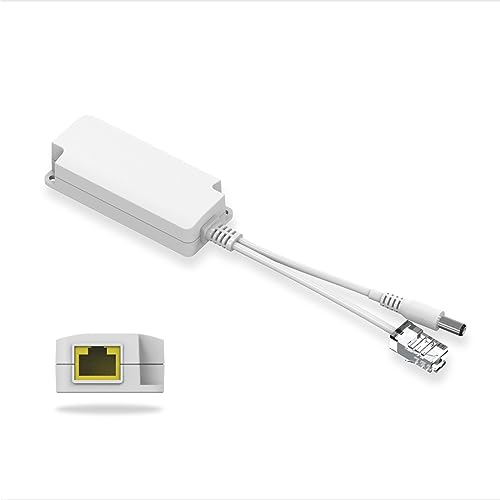

At a Glance
IP cameras run at a range of DC voltages and connector sizes even within the same brand, so a PoE splitter that works perfectly for one camera model can be physically or electrically incompatible with another, making it worth checking your exact camera's specifications before assuming any splitter fits.
We compared this lineup on real output wattage, connector compatibility, and documented device-specific warnings, since one listing specifically warns that a hardware revision change on a popular smart home camera bridge made an older splitter incompatible with the newer version.
5 Criteria to Look For Before Buying a PoE Splitters for IP Camera
Key buying criteria so you get the right fit the first time.
A Manufacturer's Hardware Revision Can Change a Camera's DC Connector Size Without Renaming the Product Line
The DSLRKIT pick specifically warns that Philips changed the DC socket on its Bridge product from 5.5x2.1mm (v1) to 5.5x2.5mm (v2), meaning a splitter that worked perfectly with an older unit of the identical product name may not physically fit a newer revision. This matters significantly if you're replacing a splitter or buying for a device you purchased more recently than your original research, since the specific hardware revision could have changed the required connector without any obvious external labeling difference. Check your exact device's current hardware revision and measure its actual DC connector size, rather than assuming a splitter that worked with an older unit of the same product name still fits a more recently purchased one.
A Splitter's Maximum Wattage May Require a Higher PoE Standard Than Your Existing Switch or Injector Provides
The REVODATA pick specifically states its full 36W output requires an IEEE 802.3bt power source, since standard 802.3at PoE+ tops out at 30W, meaning the splitter won't reach its advertised maximum wattage on older or lower-tier PoE infrastructure. This matters significantly if you're buying a high-wattage splitter specifically for a demanding camera but plan to use existing 802.3at equipment, since you'd be capped below the splitter's advertised maximum. Verify your specific PoE switch or injector's exact standard (802.3af, at, or bt) against a splitter's stated requirement for reaching its full advertised wattage.
Dual Connector Size Compatibility Removes Real Guesswork When You're Not Certain of Your Camera's Exact Barrel Plug Size
The PoE Splitter 5V2.5A pick specifically states compatibility with both 5.5x2.5mm and 5.5x2.1mm DC connectors, a genuinely practical hedge against connector size uncertainty compared to a fixed-connector splitter that only works with one specific size. This matters if you haven't physically measured your exact camera's connector or are buying before the camera arrives, and matters less if you've already confirmed the precise connector size needed. Consider a dual-compatible splitter specifically if you're uncertain of your exact camera's connector size, rather than risking a mismatched purchase with a fixed-connector alternative.
Switchable Multi-Voltage Output Serves PTZ Cameras and Accessories With Genuinely Different Power Requirements Than a Basic Camera
The LINOVISION pick's switchable 5V/9V/12V/24V output specifically accommodates scenarios like a PTZ camera with an additional wiper or IR illuminator that may require a different voltage than the camera body itself, a real multi-device power need that a fixed-voltage splitter can't address. This matters if you're installing a PTZ camera with accessories drawing different voltages, and matters less for a basic single-voltage IP camera with no additional accessories. Consider a switchable multi-voltage splitter specifically if your installation involves multiple devices or accessories with different voltage requirements sharing the same PoE source.
2.5Gbps or Gigabit Speed Support Matters More as Camera Resolution Increases Beyond Standard HD
The REVODATA pick specifically supports 2.5Gbps speed, genuinely useful for a high-resolution 4K camera that can exceed standard Gigabit bandwidth under demanding conditions, while the budget picks in this comparison cap out at 100Mbps, adequate for lower-resolution cameras but a real bottleneck for 4K footage. This matters if your specific camera records at 4K or higher resolution with high bitrate settings, and matters less for a standard 1080p or lower-resolution camera that doesn't approach even Gigabit bandwidth limits. Match a splitter's speed rating to your camera's actual resolution and bitrate requirements rather than assuming any speed rating is sufficient for your specific footage quality.
4 Best PoE Splitters for IP Cameras in 2026
REVODATA 2.5G 36W PoE Splitter, 12V/3A
About this pick
This splitter's listing specifically states 2.5Gbps Ethernet speed alongside 36W of 12V/3A output, a genuinely high-bandwidth and high-power combination for a modern 4K IP camera, requiring an IEEE 802.3bt PSE source to reach the full 36W rather than the 30W ceiling of standard 802.3at. Its multiple protection features include isolation circuit, short-circuit, and overvoltage protection.
Compared to the LINOVISION and budget picks below, this one's 2.5Gbps speed specifically future-proofs your camera installation for higher-resolution footage that exceeds standard Gigabit bandwidth.
Best for buyers with a high-power, high-bandwidth 4K camera needing both fast Ethernet and 36W of power.
Best for: buyers with a high-power, high-bandwidth 4K camera needing both fast Ethernet and 36W of power
Check price on AmazonPros
- +2.5Gbps speed future-proofs for high-resolution 4K camera footage
- +36W power ceiling handles demanding high-power cameras
- +Multiple protection features safeguard connected equipment
Cons
- −Requires an IEEE 802.3bt source to reach the full 36W
- −DC cable delivers power only, not combined with data on that connector
LINOVISION Industrial Gigabit PoE++ Splitter
About this pick
This splitter's listing specifically states a switchable output between 5V/14A, 9V/7.8A, 12V/5.9A, or 24V/3A via terminal blocks, letting one splitter accommodate cameras and accessories across dramatically different voltage requirements. Its intelligent LED indicator specifically shows which voltage output is currently active for easy verification.
Compared to the fixed-voltage picks in this comparison, this one's specifically stated application for an outdoor PTZ camera with extra wiper or IR illuminator, sharing up to 72W total power, targets demanding multi-accessory camera installations.
Best for buyers powering a PTZ camera with accessories like a wiper or IR illuminator needing multiple voltage options.
Best for: buyers powering a PTZ camera with accessories needing multiple voltage options
Check price on AmazonPros
- +Switchable voltage output accommodates cameras with different requirements
- +LED indicator shows the currently active output voltage
- +Rugged DIN-rail design suits industrial and outdoor installations
Cons
- −Highest price in this comparison by a significant margin
- −Requires a standard 802.3bt/at PoE switch, explicitly incompatible with passive BT injectors
PoE Splitter 5V2.5A Output, Dual DC Plug Compatible
About this pick
This splitter's listing specifically states DC plug compatibility with both 5.5x2.5mm and 5.5x2.1mm connector sizes, a genuinely useful dual-compatibility feature that removes guesswork about which exact barrel connector size your specific camera uses. Its 5V 2.5A output automatically detects power supply from the PSE module.
Compared to the DSLRKIT pick below, this one's dual connector compatibility and slightly higher 2.5A rating give it broader real-world fit across different 5V IP camera models without needing to verify the exact barrel size beforehand.
Best for buyers unsure of their exact camera's DC connector size who want dual compatibility.
Best for: buyers unsure of their exact camera's DC connector size who want dual compatibility
Check price on AmazonPros
- +Dual DC plug compatibility removes connector-size guesswork
- +Slightly higher 2.5A rating than the standard 2.4A splitters
- +Automatic power detection simplifies installation
Cons
- −100Mbps speed only, not Gigabit or 2.5Gbps like the pricier picks
- −Only supports 5V output, not the multi-voltage flexibility of LINOVISION
DSLRKIT DC 5V 2.4A Active PoE Splitter
About this pick
This splitter's listing specifically warns that Philips changed the DC socket size on its smart home Bridge hardware, from 5.5x2.1mm on the v1 Bridge to 5.5x2.5mm on the v2 Bridge, explicitly stating this splitter's 5.5x2.1mm plug is not compatible with the newer v2 revision, a genuinely useful and specific compatibility warning. Its 2.5KV isolation is specifically named for electrical safety.
Compared to the dual-compatible pick above, this one's lower price and explicit device-generation warning make it a good fit specifically for buyers who've verified their exact camera or smart home device revision beforehand.
Best for buyers who've confirmed their exact camera's DC connector size and want the lowest price.
Best for: buyers who've confirmed their exact camera's DC connector size and want the lowest price
Check price on AmazonPros
- +Lowest price in this comparison at under $15
- +Explicit device-generation compatibility warning prevents purchase mistakes
- +2.5KV isolation for electrical safety
Cons
- −Fixed 5.5x2.1mm connector only, not compatible with 5.5x2.5mm devices
- −May need manual LAN port speed configuration on some managed switches
How We Evaluated These PoE Splitters for IP Cameras
Each pick was assessed across 5 criteria weighted for real-world use.
Camera voltage and current fit
We matched each splitter's output against typical camera needs, since most IP cameras expect 12V and a small number expect 5V or 24V. The LINOVISION switchable 5V, 9V, 12V and 24V output stood out because one splitter covers all of them. Check the camera's power brick label before ordering.
Link speed for modern cameras
We compared the Ethernet speed each splitter passes. The REVODATA 2.5G unit handles 4K feeds with headroom, while the two 5V picks cap at 10/100Mbps, which suits small smart home cameras but limits higher resolution video. A 4K camera on a 100Mbps splitter will drop frames.
802.3bt and 802.3af source rules
We read which PoE source each unit needs. REVODATA reaches its 36W only from an 802.3bt source, and LINOVISION rejects passive injectors, so we flagged those cases for buyers using a basic af switch. Check what your switch actually outputs, not what the box says.
Connector and plug compatibility
We checked DC plug sizes, since 5.5x2.1mm and 5.5x2.5mm are both common. The 5V dual-plug unit supports both, while DSLRKIT supports only 2.1mm and warns about 12V devices, which prevents mistaken purchases. A mismatched plug means a return, so measure the barrel.
Environmental rating and protection
We weighed isolation, surge and temperature data, such as DSLRKIT's 2.5KV isolation and LINOVISION's operating range from -40F to 167F. Outdoor cameras live in heat and cold, so a listed range matters. Cold climates make this line the one to check first.
How to Choose the Right PoE Splitters for IP Cameras
By Camera Voltage
Reading the label on the camera's power brick saves a return.
| Your camera needs | Recommended pick |
|---|---|
| 12V at up to 3A for a high-power camera | REVODATA 2.5G 36W PoE Splitter, which needs an 802.3bt source for the full 36W |
| Mixed cameras at 5V, 9V, 12V and 24V across one site | LINOVISION Industrial Gigabit PoE++ Splitter, with a switchable output |
| A 5V camera or smart home device with either plug size | PoE Splitter 5V2.5A Output, Dual DC Plug Compatible, with 5.5x2.5mm and 5.5x2.1mm plugs |
| A 5V camera with a 5.5x2.1mm plug only | DSLRKIT DC 5V 2.4A Active PoE Splitter, which is not compatible with 12V devices |
By Budget
Camera splitters range from a few dollars to an industrial price tier.
| Budget | Recommended pick |
|---|---|
| The lowest price in this roundup, under $15 | DSLRKIT DC 5V 2.4A Active PoE Splitter, for smart home cameras |
| A step up for a slightly higher 2.5A rating | PoE Splitter 5V2.5A Output, Dual DC Plug Compatible, the value pick |
| A mid-range spend for 2.5Gbps and 36W | REVODATA 2.5G 36W PoE Splitter, which is the best overall |
| The highest price tier for a multi-voltage PoE++ unit | LINOVISION Industrial Gigabit PoE++ Splitter, priced significantly above the rest |
100Mbps vs 2.5Gbps Camera Links
Link speed only matters when the video bitrate demands it.
100Mbps (DSLRKIT, 5V2.5A)
A 1080p or 2K camera streaming moderate bitrates fits comfortably. These two units are cheaper and cover small indoor cameras, but they limit 4K video.
Gigabit or 2.5Gbps (REVODATA, LINOVISION)
REVODATA's 2.5Gbps and LINOVISION's Gigabit link carry high-bitrate 4K streams and leave room for future upgrades, but you must supply an appropriate PoE source.
Choose 100Mbps for budget indoor cameras and Gigabit or better for any 4K camera.
By PoE Source
The splitter only works if the switch or injector can supply its input.
| Your source | Recommended pick |
|---|---|
| A standard 802.3af switch | DSLRKIT DC 5V 2.4A Active PoE Splitter, which is 802.3af compliant |
| An 802.3af or 802.3at switch with 5V cameras | PoE Splitter 5V2.5A Output, Dual DC Plug Compatible, rated for af and at |
| An 802.3bt switch or injector | REVODATA 2.5G 36W PoE Splitter, which needs bt for its full 36W |
| A 90W 802.3bt PoE++ switch feeding several devices | LINOVISION Industrial Gigabit PoE++ Splitter, which takes a 90W input and shares 72W |
For Outdoor and Industrial Cameras Specifically
Weather and temperature will test a splitter more than any spec on the box.
Look for
A listed operating temperature range, a rugged mount and surge or isolation protection suited to long cable runs.
In this comparison
LINOVISION Industrial Gigabit PoE++ Splitter lists -40F to 167F operation and DIN-rail mounting, and REVODATA lists isolation, short-circuit and overvoltage protection.
When to Spend More
Spend more only when the camera or the site justifies it.
Spend more if
You run several camera types or a bt power budget, where LINOVISION Industrial Gigabit PoE++ Splitter at a significantly higher price covers four voltages.
Save if
You power one small 5V indoor camera, where DSLRKIT DC 5V 2.4A under $15 is enough.
Frequently Asked Questions
How do I know which DC connector size my IP camera needs for a PoE splitter?
Checking your camera's product documentation for its exact DC barrel plug specification, or physically measuring the connector, is the reliable way to confirm compatibility, though a dual-compatible splitter like the PoE Splitter 5V2.5A pick removes this guesswork if you're unsure.
What's the most common mistake buyers make when choosing a PoE splitter for a camera?
Assuming a splitter that worked with an older version of a device automatically works with a newer hardware revision of the same product, when manufacturers sometimes change connector sizes between revisions without renaming the product line.
Is the LINOVISION splitter worth the much higher price over the budget picks?
If you're specifically powering a PTZ camera with accessories like a wiper or IR illuminator needing different voltages, the LINOVISION's switchable multi-voltage design and higher price are justified, but for a basic single-voltage camera, the budget picks deliver adequate performance for much less.
Will the REVODATA splitter's full 36W output work with my existing PoE switch?
Only if your switch or injector specifically supports the IEEE 802.3bt standard; on a standard 802.3at switch, the REVODATA splitter's output will be capped below its full 36W rating, so checking your PoE source's exact standard is important.
Can I use a 5V PoE splitter with a camera that needs 12V power?
No, connecting a splitter with the wrong output voltage to your camera can cause it to malfunction or fail to power on, so verifying your camera's exact voltage requirement against the splitter's stated output before connecting is essential.
Do I need 2.5Gbps speed for a standard 1080p security camera?
No, a standard 1080p camera's bandwidth needs fall well within 100Mbps or Gigabit speed, so the 2.5Gbps REVODATA pick's extra bandwidth is specifically worth the investment only for 4K or higher-resolution camera footage.
Bottom Line
best overall: REVODATA 2.5G 36W PoE Splitter, 12V/3A - best overall pick in this roundup.
See the full rankings above for all picks with pros, cons, and best-for summaries.
Browse on Amazon
All Prime-eligible options with current pricing.
Shop on Amazon →