
4 Best 5V USB PoE Splitters in 2026
We compared 5V USB PoE splitters by connector type and amperage, since Micro USB, USB-A, and Gigabit-rated models deliver different device compatibility.

New to Amazon Prime?
Get fast, free shipping on every pick in this guide, plus Prime Video and exclusive deals.
Try Prime Free


At a Glance
UCTRONICS IEEE 802.3af Micro USB Active PoE Splitter
↓ See why we picked itA 5V USB PoE splitter converts standard PoE into the same 5V power that phones, tablets, Raspberry Pi boards, and streaming devices charge from, but the exact connector type and amperage vary enough that matching the right splitter to your specific device matters.
We compared this lineup on connector type, amperage, and speed, since one listing specifically delivers Gigabit speed at 3A while another uses a USB-A female port instead of the more common Micro USB, each fitting a genuinely different set of devices.
5 Criteria to Look For Before Buying a 5V USB PoE Splitter
Key buying criteria so you get the right fit the first time.
Micro USB and USB-A Connectors Are Not Interchangeable, So Matching the Exact Port Type Matters
Three picks in this comparison use a Micro USB connector while the fourth specifically uses a USB-A female port, two genuinely different physical connector types that determine which devices a splitter can actually power, since a Fire TV Stick's USB-A power plug won't fit a Micro USB splitter's output regardless of matching voltage and amperage. This matters significantly since buying the wrong connector type means the splitter simply won't physically connect to your device. Verify your specific device's exact charging port type (Micro USB versus USB-A) before purchasing a 5V splitter, rather than assuming any 5V splitter works with any 5V device.
Gigabit Speed Provides Real Benefit Specifically for Newer, Network-Intensive Devices Like a Raspberry Pi 4
The Gigabit Micro USB pick specifically supports full 1000Mbps data alongside its 5V/3A power output, a genuine benefit for a Raspberry Pi 4 or similar board running network-intensive applications that can exceed the 100Mbps ceiling of the standard splitters in this comparison. This matters if your specific device and use case can actually utilize bandwidth beyond 100Mbps, and matters much less for a basic Raspberry Pi 2/3 or simple streaming device that doesn't need that extra throughput. Check whether your specific device and application genuinely benefit from Gigabit speed before paying the modest premium over a standard 100Mbps splitter.
A Splitter's USB Port May Be Power-Only and Not Support Actual Data Transfer Through That Connection
The USB-A pick specifically clarifies it's not suitable for devices requiring USB data transfer like a mouse or keyboard, since its USB-A port delivers only power, not the USB data protocol those peripherals need to function. This matters if you were considering using a PoE splitter's USB output to also transmit data to a peripheral device, which won't work regardless of the splitter's power specifications, and matters less if you only need power delivery to your device (the actual network data still flows via a separate Ethernet connection on the device itself). Confirm whether your specific use case only requires power delivery through the USB port, since these splitters' USB connections are typically power-only, not data-capable.
A Documented Range Beyond the Standard 100m Limit Can Be a Genuine Differentiator for Longer Cable Runs
The UCTRONICS Micro USB pick specifically states a range up to 492ft (150m), meaningfully longer than the standard 328ft (100m) limit most PoE splitters document, giving real flexibility for a device positioned farther from the PoE source than typical. This matters if your specific installation requires reaching a device beyond the standard 100m cable limit, and matters less if your device sits comfortably within that standard range. Check a splitter's specifically documented maximum range if your installation distance is close to or exceeds the standard 100m PoE limit.
Multi-Pack Pricing Delivers Real Per-Unit Savings Only When You Actually Need That Many Splitters
The ANVISION 4-pack works out to under $8 per unit, a meaningfully lower cost per splitter than buying four single-unit UCTRONICS or Gigabit picks separately, but only delivers real value if you genuinely need to convert four separate devices at once. This matters if you're deploying multiple Raspberry Pi units, cameras, or similar devices simultaneously, where the per-unit savings add up, and matters less if you only need one splitter, where the single-unit picks avoid paying for three splitters you won't use. Calculate the actual number of devices you need to convert before choosing between a multi-pack and single-unit purchase.
4 Best 5V USB PoE Splitters in 2026
Gigabit Micro USB PoE Splitter 5V 3A (USB0503G)
About this pick
This splitter's listing specifically states full Gigabit 10/100/1000Mbps data transmission alongside 5V/3A Micro USB power output, a higher amperage and faster speed combination than the standard 2.4A, 100Mbps splitters common in this category. Its 1500V high voltage isolation circuit protection is a genuinely detailed electrical safety specification.
Compared to the UCTRONICS and ANVISION picks below, this one's Gigabit speed support makes it the strongest choice for a Raspberry Pi 4 or similar device running network-intensive applications that benefit from more than 100Mbps.
Best for buyers who want Gigabit speed with higher 3A amperage for a Raspberry Pi 4 or similar device.
Best for: buyers who want Gigabit speed with higher amperage for a Raspberry Pi 4 or similar device
Check price on AmazonPros
- +Gigabit speed supports network-intensive Raspberry Pi 4 applications
- +Higher 3A amperage than the standard 2.4A splitters
- +1500V high voltage isolation for detailed electrical protection
Cons
- −Micro USB port is power-charging only, not for data transfer
- −Higher price than the basic UCTRONICS single-pack pick below
UCTRONICS IEEE 802.3af Micro USB Active PoE Splitter
About this pick
This splitter's listing specifically states 12W of Micro USB power delivered up to 328-492ft (100-150m) via Ethernet cable, a genuinely longer documented range than the standard 100m limit found on most PoE splitters. Its 5V 2.4A output with overvoltage protection targets Android tablets, Dropcam, and Raspberry Pi 2/3B+ specifically.
Compared to the Gigabit pick above, this one's lower price makes it a straightforward choice for buyers whose Raspberry Pi or tablet doesn't need Gigabit speed, and the listing specifically notes a Gigabit-compatible model (U515902) is available separately if needed.
Best for buyers who want a straightforward, lower-priced Micro USB splitter for a Raspberry Pi 2/3B+ or tablet.
Best for: buyers who want a straightforward, lower-priced Micro USB splitter for Raspberry Pi or tablets
Check price on AmazonPros
- +Documented range up to 492ft, longer than the standard 100m limit
- +Lower price than the Gigabit pick for non-Gigabit needs
- +Specifically named compatibility with Raspberry Pi 2/3B+ and tablets
Cons
- −100Mbps speed only, not Gigabit
- −Single unit only, not a multi-pack like the ANVISION pick
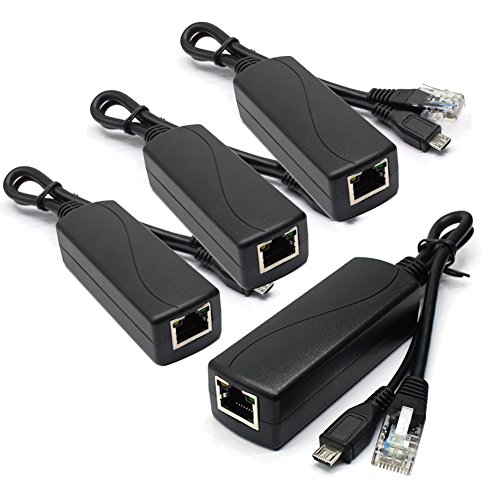
ANVISION 4-Pack Active 5V 2.4A PoE Splitter Adapter
About this pick
This adapter's listing specifically confirms a 4-pack format at DC 5V 2.4A (12W max) output with full IEEE 802.3af compliance, delivering genuine per-unit value for buyers converting multiple Dropcam, Raspberry Pi, or IP camera devices at once. Its Micro USB jack matches the same connector type as the UCTRONICS pick above.
Compared to the single-unit picks in this comparison, this one's 4-pack pricing works out to under $8 per unit, a meaningfully lower per-device cost for a multi-device deployment than buying four single units separately.
Best for buyers converting multiple Micro USB devices at once who want the best per-unit value.
Best for: buyers converting multiple Micro USB devices at once who want the best per-unit value
Check price on AmazonPros
- +4-pack delivers strong per-unit value for multiple devices
- +Consistent Micro USB connector matches common Raspberry Pi and camera needs
- +Full IEEE 802.3af compliance for standard PoE compatibility
Cons
- −100Mbps speed only, not Gigabit
- −Higher total price than single-unit picks if you only need one splitter
Active PoE Splitter USB A 5V 2.4A
About this pick
This splitter's listing specifically names compatibility with Fire TV Stick, Roku, Echo Dot, baby monitors, and USB security cameras that charge via a standard USB-A female port, a genuinely different connector type than the Micro USB splitters in this comparison, while explicitly noting it's not suitable for devices requiring USB data transfer like a mouse or keyboard. Its 18-month warranty is the longest stated coverage among the picks in this comparison.
Compared to the Micro USB picks above, this one's USB-A female output specifically matches streaming sticks and smart speakers that use a standard USB-A power plug rather than Micro USB or USB-C.
Best for buyers powering a Fire TV Stick, Roku, Echo Dot, or other USB-A powered device.
Best for: buyers powering a Fire TV Stick, Roku, Echo Dot, or other USB-A powered device
Check price on AmazonPros
- +USB-A connector matches Fire TV Stick, Roku, and Echo Dot power needs
- +Longest stated warranty in this comparison at 18 months
- +Explicit clarification on which device types it does and doesn't support
Cons
- −Not suitable for devices requiring USB data transfer, power only
- −100Mbps speed only, not Gigabit
How We Evaluated These 5V USB PoE Splitters
Each pick was assessed across 5 criteria weighted for real-world use.
Connector type
The first mistake with 5V splitters is the plug. We sorted the picks into Micro USB (the 5V 3A model, UCTRONICS, ANVISION) and USB-A female output. Micro USB suits older Raspberry Pi boards and cameras, while the USB-A unit works with a separate cable.
Amperage at 5V
We compared 5V current: 3A (15W) for the Gigabit unit and 2.4A (12W) for the rest. A device with a power-hungry radio or USB peripherals may need the higher current to avoid brownouts. We took that as a practical rule: a long run helps only when the wire gauge is decent, so we checked each page for cable guidance.
Data speed
The first model is Gigabit while ANVISION is listed at 100Mbps. A splitter in the data path becomes the speed ceiling, so we scored 100Mbps as acceptable for a camera and a limit for a Pi used as a server. At 100Mbps the splitter limits any device that also needs to move big files, so we noted it for each pick.
Isolation and protection
The first pick lists 1500V isolation with short-circuit and overvoltage protection, and the UCTRONICS lists overvoltage protection. We favored isolation because it protects the device when the PoE side has a surge. The wording matters, since a device that survives a nearby lightning strike is worth more than a marketing mention.
Range and warranty
UCTRONICS lists up to 492ft (150m) and the USB-A model lists 100m with an 18-month warranty. We treated the longer range as a bonus only where the 802.3af standard still holds at that length. An 18-month warranty on the USB-A unit counted for something, and range claims were treated as upper bounds, not promises.
How to Choose the Right 5V USB PoE Splitters
By Device Plug
Plug type decides which of these four works at all.
| Your device | Recommended pick |
|---|---|
| A Raspberry Pi 3 or a camera with Micro USB power | Gigabit Micro USB PoE Splitter 5V 3A (USB0503G), with 5V at 3A |
| A Micro USB device on a very long cable run | UCTRONICS 802.3af Micro USB Active PoE Splitter, listed to 492ft |
| Four cameras or boards that each need Micro USB | ANVISION 4-Pack Active 5V 2.4A PoE Splitter Adapter, as a pack of four |
| A device with a standard USB-A cable such as a USB camera | Active PoE Splitter USB A 5V 2.4A, with a USB-A female output |
By Budget
The group spans under $10 to under $30, but per-unit cost is similar.
| Price tier | Recommended pick |
|---|---|
| Under $10, one USB-A unit | Active PoE Splitter USB A 5V 2.4A, the cheapest single splitter |
| Under $11, one Micro USB unit | UCTRONICS, for single Micro USB devices |
| Under $14, Gigabit and 3A | Gigabit Micro USB PoE Splitter 5V 3A, with the highest amperage here |
| Under $30, four units | ANVISION 4-Pack, which is about the cost of one per device |
Gigabit vs 100Mbps Splitters
This is a more important choice than it looks, since the splitter sits in the data path.
Gigabit (Gigabit Micro USB PoE Splitter 5V 3A)
Choose this when the device is a mini server, NAS, or a Pi that moves files. The cable run and 3A current come with the same box.
100Mbps (ANVISION 4-Pack, UCTRONICS, Active PoE Splitter USB A)
Perfectly fine for a camera or sensor. The lower speed rarely matters for video that streams at a few Mbps.
Default to 100Mbps for cameras and only buy Gigabit for devices that move big files.
By Amperage Need
Many 5V devices peak above what they idle at.
| Your load | Recommended pick |
|---|---|
| A Pi 3 with a camera module and no USB drives | UCTRONICS, at 2.4A |
| A device with USB peripherals that can spike | Gigabit Micro USB PoE Splitter 5V 3A, at 3A |
| Low-power sensors in bulk | ANVISION 4-Pack, at 2.4A each and 12W max per splitter |
For a Pi Zero or Raspberry Pi Camera Specifically
Small boards are the main reason people buy 5V splitters.
Look for
A Micro USB plug, at least 2.4A, and clean isolation so a surge on the cable does not hit the board.
In this comparison
The Gigabit Micro USB PoE Splitter 5V 3A offers 1500V isolation at 3A, while the UCTRONICS suits a longer cable run.
When to Spend More
Differences here are small in cost.
Spend more if
You need Gigabit or 3A. The Gigabit Micro USB PoE Splitter 5V 3A costs a little more than the others, and the budget splitter guide covers units with adjustable voltage.
Save if
You are powering a basic camera. The Active PoE Splitter USB A and UCTRONICS cost the least.
Frequently Asked Questions
Can a 5V PoE splitter power a Raspberry Pi 4?
The Pi 4 uses USB-C and wants up to 3A, while these four use Micro USB or USB-A at 2.4A to 3A. A Micro USB splitter will not fit without an adapter, so buy a USB-C unit instead. Check the board's power port before ordering.
What mistake do buyers make with a 5V splitter?
Buying on amperage alone. A 2.4A splitter powers a camera, but a Pi with a USB drive can exceed 12W. Check the device's maximum draw, including peripherals, before choosing between 2.4A and 3A. Add up the board, camera module, and any USB drive draw.
Is the Gigabit 5V 3A splitter worth paying more than the UCTRONICS?
If the device moves large files or needs 3A, yes. For a basic camera at 100Mbps and 2.4A, the UCTRONICS covers the job and offers a stated range of 492ft. Keep the 3A model for devices with peripherals.
How do I connect one of these to a PoE switch?
Plug the Ethernet cable from the PoE switch into the splitter's input, then connect the Micro USB or USB-A output to the device and its Ethernet to the device. Use a standard 802.3af port. The connection order does not matter as long as the cables are solid.
Can I run a 5V splitter on a passive PoE injector?
Only if the injector outputs 44 to 57V, the range listed on these units. A 24V passive injector is below that input range and will not power the splitter, so use an 802.3af-compatible source. Check the injector's label for its output voltage.
Why does my device reboot with a 2.4A splitter?
A burst draw above 2.4A drops the voltage, and the device resets. Disconnect peripherals, use the 3A model, or shorten the cable. A short, thick cable also reduces voltage loss at the connector. A 12V brick left on the wrong port is never the answer.
Bottom Line
best overall: Gigabit Micro USB PoE Splitter 5V 3A (USB0503G) - best overall pick in this roundup.
See the full rankings above for all picks with pros, cons, and best-for summaries.
Browse on Amazon
All Prime-eligible options with current pricing.
Shop on Amazon →