
4 Best Multi-Port and Rackmount PoE Injectors in 2026
We compared multi-port PoE injectors by real port count and total power budget, since a 4-port and 24-port unit serve very different installation scales.

New to Amazon Prime?
Get fast, free shipping on every pick in this guide, plus Prime Video and exclusive deals.
Try Prime Free


At a Glance
PoE Texas 12-Port Gigabit Passive PoE Injector, 48V 120W
↓ See why we picked itA multi-port midspan PoE injector lets you add PoE to an entire bank of existing non-PoE switch ports at once, avoiding the cost of replacing a whole switch just to power a group of cameras, phones, or access points.
We compared this lineup on real port count and total power budget across a single trusted brand's product line, since choosing the right port count for your specific device count matters more here than any single spec, and buying a 24-port unit for a 4-device installation wastes significant money.
5 Criteria to Look For Before Buying a Multi-Port and Rackmount PoE Injector
Key buying criteria so you get the right fit the first time.
A Multi-Port Injector's Total Power Budget Is Shared Across All Connected Devices, Not Per-Port
A listing's total wattage, like the 8-port pick's 60W budget, is divided among however many devices you actually connect, meaning 8 devices each drawing close to the maximum share could exceed the total budget even though each individual port could theoretically handle more in isolation. This matters significantly if you're powering higher-draw devices like PTZ cameras across many ports simultaneously, and matters less if your devices are low-draw items like basic VoIP phones that use only a small fraction of the available per-port share. Add up your actual devices' combined power draw and compare it against the injector's total stated wattage budget, not just the per-port maximum, before assuming full capacity is available.
Passive PoE at the Multi-Port Tier Requires Confirming Mode A or Mode B Compatibility With Your Specific Devices
Passive PoE injectors deliver power on a specific pin configuration, either Mode A (pins 1,2 and 3,6) or Mode B (pins 4,5 and 7,8), and while most modern 802.3af/at devices support both modes automatically, confirming your specific device's compatibility avoids a rare mismatch. This matters more if you're connecting older or less common equipment where mode support isn't guaranteed, and matters less with standard modern IP cameras and access points that typically support both modes. Check your device's own documentation for its supported PoE mode if you have any uncertainty, particularly with older or specialized hardware.
Right-Sizing Port Count to Your Actual Device Count Avoids a Steep, Unnecessary Price Jump
The price difference between tiers in a multi-port injector line isn't linear, jumping from roughly $48 for 8 ports to nearly $175 for 12 ports in this comparison, meaning buying more headroom than you need costs disproportionately more than the extra capacity is worth if you don't have concrete plans to use it. This matters significantly for a budget-conscious deployment where every dollar counts, and matters less for an organization planning known near-term expansion where buying ahead avoids a second purchase and installation visit later. Count your actual current devices plus any confirmed near-term additions before choosing a port-count tier, rather than defaulting to the next size up as a safety margin.
Fast Ethernet Versus Gigabit Speed Matters More at Higher Device Counts Where Aggregate Bandwidth Adds Up
A single 100Mbps device rarely feels a real-world speed limitation, but when you're running 8, 12, or 24 devices through a shared multi-port injector, the aggregate bandwidth need across all connected devices, especially cameras streaming continuously, can meaningfully benefit from Gigabit-per-port speed compared to Fast Ethernet. This matters more for a camera-heavy deployment where multiple high-resolution feeds run simultaneously, and matters less for a phone-heavy deployment where each device's individual bandwidth need is minimal regardless of port speed. Check whether your specific mix of devices and their combined bandwidth need justifies paying for Gigabit over Fast Ethernet at your chosen port count.
Whether a Power Supply Is Included in the Listed Price Significantly Affects the Real Total Cost at Larger Port Counts
At higher port counts, the power supply itself becomes a more substantial cost component, and confirming whether a listing's price already includes a UL-approved power supply, as several picks in this comparison do, avoids an unexpected additional purchase to actually get the unit running. This matters for accurately comparing prices across different multi-port injector options, since two listings with similar headline prices could differ meaningfully in real total cost if one requires a separately purchased power supply. Check the listing's included-items section specifically for confirmation the power supply is bundled before finalizing a budget comparison.
4 Best Multi-Port and Rackmount PoE Injectors in 2026
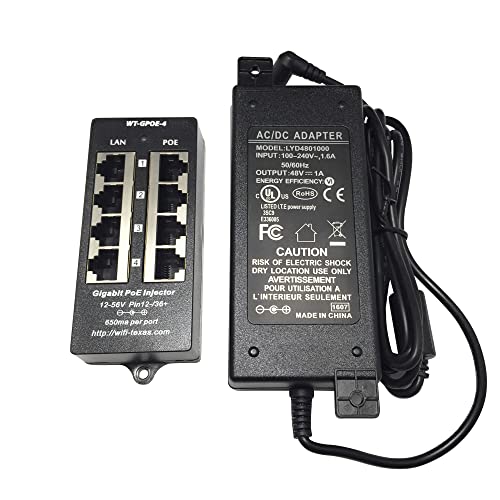
PoE Texas 4-Port Gigabit Passive PoE Injector
About this pick
This injector's listing specifically states a 48V 48W included power supply across 4 data-in and 4 PoE data-out ports, using Mode A negotiation on pins 1,2 and 3,6 for 802.3af and 802.3at compatible devices. Its full Gigabit speed across all 4 ports avoids the throughput bottleneck a Fast Ethernet-only multi-port unit would introduce.
Compared to the 8-port pick below, this one suits a smaller installation, like a single office or small retail location with just a handful of cameras or phones, without paying for unused port capacity.
Best for buyers with 4 or fewer devices needing PoE who want Gigabit speed without paying for a larger port count.
Best for: buyers with 4 or fewer devices needing PoE at Gigabit speed
Check price on AmazonPros
- +Lowest price in this comparison for a multi-port unit
- +Full Gigabit speed across all 4 ports
- +Included power supply covers the full 48W budget
Cons
- −Passive PoE only, always-on power without standard negotiation
- −Limited to 4 devices, not expandable
PoE Texas 8-Port Passive PoE Injector, 48V 60W
About this pick
This injector's listing specifically states 8 data-in ports paired with 8 PoE data-out ports sharing a 48V 60W total power budget, using Mode B negotiation on pins 4,5 and 7,8 for 802.3af or 802.3at compatible devices. Its included power supply is bundled into the price, unlike some larger units in this comparison that separate the two costs.
Compared to the 4-port pick above, this one doubles the port count for just $7 more, a strong value if you're at or near 8 devices, though it steps down to 10/100Mbps rather than full Gigabit.
Best for buyers with up to 8 devices who want the best port-count-to-price ratio in this comparison.
Best for: buyers with up to 8 devices who want the best port-count-to-price ratio
Check price on AmazonPros
- +Doubles the port count of the 4-port pick for a small price increase
- +Included power supply bundled into the listed price
- +Solid value for a small-to-medium camera or phone deployment
Cons
- −10/100Mbps only, not Gigabit like the 4-port pick
- −Passive PoE only, not standard negotiated PoE
PoE Texas 12-Port Gigabit Passive PoE Injector, 48V 120W
About this pick
This injector's listing specifically states 12 Gigabit data-in ports paired with 12 Gigabit PoE data-out ports and transparent VLAN passthrough, sharing an included UL-approved 48V 120W power supply. Its Mode A or Mode B compatibility, with other power supply bundles available from the same manufacturer, offers more flexibility for matching different device requirements.
Compared to the 24-port pick below, this one suits a mid-size deployment, like a single-floor office or a mid-size retail location, at roughly 60% of the larger unit's price.
Best for buyers with up to 12 devices in a mid-size installation who need Gigabit speed and VLAN passthrough.
Best for: buyers with up to 12 devices in a mid-size installation needing Gigabit speed
Check price on AmazonPros
- +Full Gigabit speed across all 12 ports
- +VLAN passthrough supports segmented network setups
- +UL-approved power supply included in the price
Cons
- −Significant price jump from the 4 and 8-port picks
- −Passive PoE only, not standard negotiated PoE
PoE Texas 24-Port Gigabit PoE Injector, 56V 240W
About this pick
This injector's listing specifically states two included 56V 120W power supplies for a combined 240W total budget across 24 Gigabit ports, letting you power up to 24 IP cameras, phones, or access points from a single rack-mounted unit rather than a dedicated PoE switch. Its rack-mount form factor is built specifically for a server closet or equipment rack installation.
Compared to the 12-port pick above, this one doubles the port count for roughly 70% more cost, a reasonable scaling ratio for a genuinely large deployment like a full office floor or a large retail location.
Best for buyers with up to 24 devices in a large installation who want to avoid the cost of a full 24-port PoE switch.
Best for: buyers with up to 24 devices in a large installation avoiding a full PoE switch purchase
Check price on AmazonPros
- +Avoids the cost of upgrading to a full 24-port PoE switch
- +Rack-mount design suits a server closet installation
- +Highest total power budget in this comparison at 240W
Cons
- −Highest price in this comparison by a wide margin
- −Passive PoE only, not standard negotiated PoE
How We Evaluated These Multi-Port and Rackmount PoE Injectors
Each pick was assessed across 5 criteria weighted for real-world use.
Port count scaling
We compared how the four PoE Texas units step from 4 to 8 to 12 to 24 ports, and what each jump costs. The 8-port unit doubles the 4-port for a small premium, but the 24-port is several times the price, so we counted the real cost per port at each tier.
Total power budget, not per port
The 4-port gives 48W total, the 8-port 60W, the 12-port 120W and the 24-port 240W. That means the 8-port averages only 7.5W per port if fully loaded, which cannot run eight cameras drawing 12W. We checked every tier against realistic device draw.
Port speed against the camera load
The 4, 12 and 24-port units are Gigabit, while the 8-port is 10/100Mbps Fast Ethernet. We checked this because aggregate bandwidth from several high-resolution cameras can exceed 100Mbps, and a Fast Ethernet port then caps the whole group.
Power supply inclusion
All four list an included supply, including a UL-approved one on the 12-port and two 56V 120W supplies on the 24-port. Because a missing supply can add a large cost at higher port counts, we only treated the listed prices as comparable where the supply is actually bundled.
Passive mode and rack suitability
The 4-port uses Mode A and the 8-port Mode B, while the 24-port is rack-mountable. We noted this because passive PoE sends power without negotiation, so a mismatch in pin mode can leave a device dark or stress it, and rack mounting matters in a closet.
How to Choose the Right Multi-Port and Rackmount PoE Injectors
By Device Count
Count the devices you will power in the next year, then match the injector tier and its shared wattage budget.
| Your situation | Recommended pick |
|---|---|
| Up to 4 cameras or access points, Gigabit needed | PoE Texas 4-Port Gigabit Passive PoE Injector, with 48W total shared across all four ports |
| 5 to 8 low-draw devices on 100Mbps links | PoE Texas 8-Port Passive PoE Injector, though 60W total averages only 7.5W per port |
| 9 to 12 devices with Gigabit uplinks | PoE Texas 12-Port Gigabit Passive PoE Injector, with a 120W budget and VLAN passthrough |
| 13 to 24 devices in a rack or closet | PoE Texas 24-Port Gigabit PoE Injector, with 240W across two bundled supplies |
By Budget
Cost per port falls up to 12 ports, then the 24-port tier is a big step up.
| Price range | Recommended pick |
|---|---|
| Under $45, one small room of devices | PoE Texas 4-Port Gigabit Passive PoE Injector, the cheapest entry and still full Gigabit |
| Under $50, more ports at low speed | PoE Texas 8-Port Passive PoE Injector, best cost per port but capped at 100Mbps |
| Under $180, a mid-size install | PoE Texas 12-Port Gigabit Passive PoE Injector, the sweet spot for Gigabit and a UL-approved supply |
| Under $300, a full rack | PoE Texas 24-Port Gigabit PoE Injector, still far below a comparable managed PoE switch |
Buying a Larger Unit vs Right-Sizing
Buying larger for headroom
A 12-port unit for 8 devices leaves four spare ports, which saves a second purchase if growth is likely. The catch is the shared 120W budget, which is fixed no matter how many ports you fill.
Right-sizing to current needs
Matching the 4-port or 8-port unit to today's device count avoids paying for ports you may never use, and these two tiers cost only a few dollars apart.
Most buyers should right-size plus one or two spare ports, since the jump from the 12-port to the 24-port is several times the price.
By Port Speed Requirement
Aggregate bandwidth is what Fast Ethernet cannot handle, so choose the speed by the cameras and not the port count.
| Your situation | Recommended pick |
|---|---|
| Several 4K or 5MP cameras on one uplink | PoE Texas 12-Port Gigabit Passive PoE Injector, so ports are not capped at 100Mbps |
| Four mixed devices needing full speed | PoE Texas 4-Port Gigabit Passive PoE Injector, with Mode A and Gigabit on every port |
| Eight older 720p or 1080p cameras | PoE Texas 8-Port Passive PoE Injector, since Fast Ethernet is enough for low bitrates |
| A closet feeding many cameras and APs | PoE Texas 24-Port Gigabit PoE Injector, rackmounted with a Gigabit port for each device |
For a Server Closet or Rack Installation Specifically
Look for
Rack ears or a rack-mount form factor, a power supply that fits your shelf, and enough total wattage. At 24 ports, one 240W budget is shared, so two or three high-draw devices can eat most of it.
In this comparison
The PoE Texas 24-Port Gigabit PoE Injector is the rack-mountable pick, with two included 56V 120W supplies that keep a closet tidy compared with 24 loose adapters.
When to Spend More
Spend more if
You are powering 10 or more devices and want to avoid the cost and complexity of a full PoE switch. The PoE Texas 12-Port Gigabit and 24-Port units give you Gigabit speed and bundled supplies for far less than switch pricing.
Save if
You have 4 to 8 devices on one site. The PoE Texas 4-Port Gigabit injector under $45 handles that, and the 8-port is the better value if 100Mbps links are enough.
Frequently Asked Questions
How many devices can a multi-port PoE injector actually support?
Check both the stated port count and the total power budget together; a device count matching the port count only works if your devices' combined power draw stays within the total wattage the unit provides.
Is a multi-port PoE injector cheaper than a PoE switch?
Often yes, especially if you already have a working non-PoE switch, since a midspan injector lets you add PoE capability without replacing that switch entirely, though at very high port counts the price gap narrows.
What's the difference between Mode A and Mode B passive PoE?
They're different pin configurations for delivering power over the Ethernet cable, and most modern 802.3af/at devices support both automatically, though it's worth confirming with older or specialized equipment.
Should I buy a larger port-count unit than I currently need?
Add headroom, but only a small amount. The price rises steeply past 12 ports, so a 12-port unit for 8 cameras is sensible, while jumping to the 24-port for future growth costs several times as much. Also check the total budget: 120W shared by 12 ports still limits what each camera can draw.
Do I need Gigabit speed for a multi-port PoE injector powering security cameras?
For higher-resolution or multiple simultaneous camera feeds, yes; for basic single cameras or a phone-heavy deployment, Fast Ethernet (10/100Mbps) is often sufficient and available at a lower cost.
Can a multi-port PoE injector be rack-mounted?
Higher port-count units, like the 24-port pick in this comparison, are specifically designed for rack mounting, while smaller 4 and 8-port units are typically standalone desktop or wall-mounted designs.
Bottom Line
best overall: PoE Texas 4-Port Gigabit Passive PoE Injector - best for small deployments pick in this roundup.
See the full rankings above for all picks with pros, cons, and best-for summaries.
Browse on Amazon
All Prime-eligible options with current pricing.
Shop on Amazon →