
7 Best Network Switches for Gaming in 2026
Gaming benefits more from low latency and QoS than raw bandwidth. We covered both budget Gigabit and premium multi-gig options.

New to Amazon Prime?
Get fast, free shipping on every pick in this guide, plus Prime Video and exclusive deals.
Try Prime Free


At a Glance
Gaming performance depends far more on low, consistent latency than raw bandwidth, a wired Gigabit connection through any decent switch already beats WiFi by a wide margin on latency consistency, so the real decision is between budget plug-and-play options and premium multi-gig switches for LAN parties or content creation alongside gaming.
We covered both tiers honestly: budget Gigabit switches that cover the vast majority of gaming needs, and premium 2.5G/10G options genuinely useful for LAN party setups or gamers who also stream and transfer large files.
6 Criteria to Look For Before Buying a Network Switches for Gaming
Key buying criteria so you get the right fit the first time.
Port count is a headroom decision, not a current-need one
Buy for what you'll plug in over the next 2-3 years, not just today. A network switches for gaming that's already full the day it arrives means buying a second switch and daisy-chaining, which adds a hop of latency and another point of failure. Count your realistic near-future device list, including anything you're likely to add, before settling on a port count.
PoE budget is a shared pool, not per-port
PoE wattage on network switches for gaming is a shared budget across all ports, not a guaranteed per-port allocation, so don't assume every port can simultaneously draw its rated maximum. Total your real connected devices' draw and compare against the switch's stated PoE budget before buying. This is the detail that causes devices to underperform or fail to power on once a switch is fully populated.
Managed vs unmanaged changes what you can diagnose later
An unmanaged switch is zero-configuration but gives you no visibility when something goes wrong. A smart-managed switch adds VLANs, port mirroring, and traffic monitoring for a modest price increase, worth it the first time you need to isolate a misbehaving device. Decide which category you're actually buying before comparing prices, since the feature gap matters more than it looks on a spec sheet.
Fanless does not always mean silent under load
Fanless doesn't automatically mean silent under real load, once a PoE switch's power budget climbs past roughly 200-300W, some models add active cooling despite a "fanless" category label. Check network switches for gaming's spec sheet explicitly for fan presence if noise matters for your install location. Don't assume quiet from the category alone.
Multi-gig speed needs matching cable and network gear
A multi-gig switch only delivers those speeds if your cabling is Cat5e or better (Cat6a for 10G) and the devices on both ends actually support that speed. Mixing a multi-gig switch into an all-Gigabit network gets you nothing extra beyond standard Gigabit performance. Confirm both the cabling and the connected devices support the higher speed before expecting to see it.
Renewed enterprise gear needs a licensing check first
Renewed enterprise gear, including network switches for gaming sold this way, commonly ships without an active license or support contract that newer units include by default. Check exactly what's functional on a specific renewed listing before assuming full feature parity with new hardware. This gap is rarely disclosed clearly in the listing title.
7 Best Network Switches for Gaming in 2026
TP-Link TL-SG108S-M2 8-Port 2.5G Unmanaged Switch
About this pick
The TL-SG108S-M2 delivers 8 full 2.5Gbps ports with 40Gbps of switching capacity, auto-negotiating across 100Mb/1G/2.5G speeds so it drops right into a mixed-speed network without configuration.
TP-Link is explicit that the 2.5G upgrade works over existing Cat5e cabling, no need to rewire to Cat6 first, which meaningfully lowers the real cost of a multi-gig upgrade for LAN parties, home offices, or small studios.
Best for: buyers prioritizing 8x 2.5g ports, 40gbps capacity
Check price on AmazonPros
- +No Cat6 rewiring required for 2.5G speeds
- +Fanless despite the multi-gig jump
- +Auto-negotiates cleanly with Gigabit gear
Cons
- −Unmanaged, no VLAN or QoS controls
- −2.5G ceiling, not a path to 5G/10G
BrosTrend 8-Port 2.5Gb Unmanaged Switch
About this pick
BrosTrend's 2.5G switch delivers full 2.5Gbps across all 8 RJ45 ports with 40Gbps switching capacity, no SFP complexity, just straightforward copper ports for gaming, home office, or LAN party setups.
It's genuinely plug-and-play with no software required, and the fanless design stays whisper-quiet even under demanding multi-device gaming or streaming loads.
Best for: buyers prioritizing 8x 2.5gb ports, 40gbps capacity
Check price on AmazonPros
- +Full 2.5Gbps on all 8 ports without SFP complexity
- +Fanless even under gaming/streaming loads
- +Simple plug-and-play setup
Cons
- −No management features
- −Smaller brand than TP-Link/NETGEAR
TRENDnet TEG-S380 8-Port 2.5Gb Gaming Switch
About this pick
The TEG-S380 matches the TEG-S381's 8-port 2.5G spec sheet with the same 40Gbps switching capacity and lifetime protection, marketed specifically toward gaming setups needing low-latency multi-gig connectivity.
Backward compatibility with 1000Mbps devices means it drops cleanly into an existing Gigabit network while giving a clear upgrade path as more devices adopt 2.5G.
Best for: buyers prioritizing 8x 2.5g ports, 40gbps capacity
Check price on AmazonPros
- +Same lifetime warranty as TRENDnet's TEG-S381
- +Backward compatible with Gigabit devices
- +Fanless silent operation for gaming setups
Cons
- −Functionally near-identical to the TEG-S381
- −Unmanaged, no VLAN/QoS
NETGEAR MS308 8-Port 2.5G Unmanaged Switch
About this pick
The MS308 brings NETGEAR's zero-configuration philosophy to 8 x 2.5Gbps ports, auto-negotiating with existing Cat5e or Cat6 cabling, sharing the same fanless energy-efficient design as NETGEAR's Gigabit GS-series.
It's a straightforward multi-gig upgrade path for buyers who trust NETGEAR's build quality and want true plug-and-play simplicity at 2.5G speeds rather than a managed switch's added complexity.
Best for: buyers prioritizing 8x 2.5g ports, fanless
Check price on AmazonPros
- +Trusted NETGEAR build quality at 2.5G speeds
- +No cable rewiring needed for 2.5G
- +Fanless despite the multi-gig jump
Cons
- −No management features
- −US/CA regional model only
TP-Link TL-SG105S-M2 5-Port 2.5G Unmanaged Switch
About this pick
TP-Link's 5-port 2.5G switch mirrors the TL-SG108S-M2's Cat5e-compatible multi-gig upgrade path in a smaller form factor, delivering 25Gbps of switching capacity across 5 ports.
Measuring 5.45 x 4.96 x 3.98 inches in a durable metal case, it's sized for a desk or small closet rather than a rack, targeting home offices and gaming setups that don't need 8 ports of 2.5G.
Best for: buyers prioritizing 5x 2.5g ports, 25gbps capacity
Check price on AmazonPros
- +Smaller footprint than the 8-port 2.5G sibling
- +No cable rewiring needed for 2.5G
- +Fanless silent operation
Cons
- −Only 5 ports for a multi-gig upgrade
- −Unmanaged, no QoS/VLAN
TP-Link TL-SG105 5-Port Gigabit Unmanaged Switch
About this pick
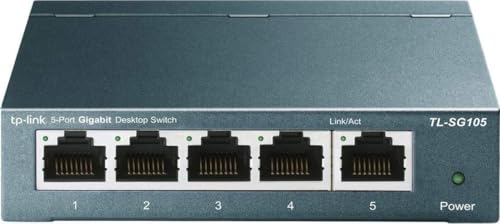
The TL-SG105 is TP-Link's 5-port entry point, with Port-based 802.1p/DSCP QoS and IGMP Snooping baked in even though the switch itself is otherwise unmanaged, useful for prioritizing video or voice traffic without a management interface.
It ships with a 3-year warranty and free technical support, and its metal casing supports both desktop and wall-mount placement. IEEE 802.3X flow control keeps data transfer reliable even on a saturated small network.
Best for: buyers prioritizing 5 gigabit ports, qos + igmp snooping
Check price on AmazonPros
- +QoS traffic prioritization unusual for unmanaged tier
- +3-year warranty plus free support
- +Energy-efficient design lowers running cost
Cons
- −Only 5 ports limits room to grow
- −No web interface despite QoS features
How We Evaluated These Network Switches for Gaming
Each pick was assessed across 5 criteria weighted for real-world use.
Port Count & Speed Tier
Verified the actual port count, Gigabit vs multi-gig speed rating, and whether every port runs at the advertised speed or only some do, since several switches mix full-speed and lower-speed ports.
PoE Power Budget
Checked the total PoE wattage budget against realistic device counts, not just the per-port maximum, since a switch's total power pool is what actually limits how many cameras or access points it can run.
Management Depth
Classified each switch as unmanaged, smart/easy-managed, or fully managed Layer 2/3, since this determines what troubleshooting and segmentation options are available after installation, not just at setup.
Build & Mounting Flexibility
Weighed fanless vs active cooling, metal vs plastic housing, and desktop/wall/rack mounting options against the switch's likely install environment.
Real-World Documentation Honesty
Favored listings that clearly state cabling requirements, host port requirements, and speed caveats over ones that only advertise the theoretical maximum.
How to Choose the Right Network Switches for Gaming
Budget Gigabit vs Premium Multi-Gig for Gaming
| Your setup | Best pick |
|---|---|
| Single gaming PC, standard internet plan | TP-Link TL-SG105, plenty for gaming latency |
| LAN parties or streaming while gaming | 2.5G switch like TL-SG108S-M2 handles simultaneous high-bandwidth tasks |
QoS for Latency-Sensitive Gaming
If other household devices compete for bandwidth during gaming sessions, a smart-managed switch with QoS can prioritize gaming traffic over background downloads or streaming, worth considering over a purely unmanaged option in a busy household.
When to Spend More
Spend more if
NETGEAR MS308 8-Port 2.5G Unmanaged Switch is aimed at buyers prioritizing 8x 2.5g ports, fanless.
Save if
TP-Link TL-SG105 5-Port Gigabit Unmanaged Switch is aimed at buyers prioritizing 5 gigabit ports, qos + igmp snooping.
TP-Link TL-SG105 5-Port Gigabit Unmanaged Switch vs NETGEAR MS308 8-Port 2.5G Unmanaged Switch
TP-Link TL-SG105 5-Port Gigabit Unmanaged Switch
Aimed at buyers prioritizing 5 gigabit ports, qos + igmp snooping.
NETGEAR MS308 8-Port 2.5G Unmanaged Switch
Aimed at buyers prioritizing 8x 2.5g ports, fanless.
Default to TP-Link TL-SG105 5-Port Gigabit Unmanaged Switch unless the pricier pick's specific advantage genuinely applies to your situation.
Matching a Pick to Your Primary Use Case
Look for
The specific capability your main use case actually depends on, stated explicitly in the listing, not implied by price or category alone.
In this comparison
TP-Link TL-SG108S-M2 8-Port 2.5G Unmanaged Switch is aimed at buyers prioritizing 8x 2.5g ports, 40gbps capacity; BrosTrend 8-Port 2.5Gb Unmanaged Switch is aimed at buyers prioritizing 8x 2.5gb ports, 40gbps capacity.
For Budget-Conscious Buyers Specifically
Look for
The lowest price that still covers your actual must-have requirements, not just the lowest price on the page.
In this comparison
TP-Link TL-SG105 5-Port Gigabit Unmanaged Switch is aimed at buyers prioritizing 5 gigabit ports, qos + igmp snooping, at under $15.
Frequently Asked Questions
Does a more expensive switch reduce gaming lag?
Marginally at best. A switch adds well under 1ms of latency regardless of price tier once you're on a wired Gigabit connection; your actual ping is determined by your internet connection and the game server's distance, not the switch.
Which pick in this comparison is the best overall choice?
TP-Link TL-SG108S-M2 8-Port 2.5G Unmanaged Switch is aimed at buyers prioritizing 8x 2.5g ports, 40gbps capacity.
Which pick offers the best value for a tight budget?
TP-Link TL-SG105 5-Port Gigabit Unmanaged Switch is aimed at buyers prioritizing 5 gigabit ports, qos + igmp snooping, and at under $15 it's the lowest-cost pick in this comparison.
What's the price range across the picks in this comparison?
Prices here range from roughly $15 to $110, so match your choice to both your budget and actual needs rather than defaulting to either extreme.
Is the most expensive pick in this comparison worth the extra cost?
NETGEAR MS308 8-Port 2.5G Unmanaged Switch is aimed at buyers prioritizing 8x 2.5g ports, fanless. Whether that's worth the premium over the cheaper picks depends on whether that specific advantage matters for your use case.
Is there a solid middle-ground pick if the cheapest and priciest options don't fit?
TP-Link TL-SG108S-M2 8-Port 2.5G Unmanaged Switch is aimed at buyers prioritizing 8x 2.5g ports, 40gbps capacity.
Bottom Line
best overall: TP-Link TL-SG108S-M2 8-Port 2.5G Unmanaged Switch - best 2.5g gaming switch pick in this roundup.
See the full rankings above for all picks with pros, cons, and best-for summaries.
Browse on Amazon
All Prime-eligible options with current pricing.
Shop on Amazon →