
4 Best 2.5GbE and 5GbE PoE Injectors in 2026
We compared 2.5GbE PoE injectors by real surge protection and warranty length, since two listings state specific kV ratings while others rely on general claims.

New to Amazon Prime?
Get fast, free shipping on every pick in this guide, plus Prime Video and exclusive deals.
Try Prime Free


At a Glance
A 2.5GbE PoE injector avoids the throughput bottleneck a standard Gigabit unit introduces once you're running a Wi-Fi 6E or Wi-Fi 7 access point capable of pushing more than 1Gbps of real aggregate traffic under load.
We compared this lineup on real surge protection and warranty length, since two listings specifically state documented kV surge and ESD ratings alongside multi-year manufacturer warranties, while others rely on general overvoltage protection claims without a specific number attached.
5 Criteria to Look For Before Buying a 2.5GbE and 5GbE PoE Injector
Key buying criteria so you get the right fit the first time.
A '2.5GbE' Label Should Be Confirmed as True 2.5Gbps Throughput, Not Just a Gigabit Port With Marketing Language
Every listing in this comparison explicitly states support for 2.5Gbps or 802.3bz compliance, but in a broader market search, some injectors labeled with 2.5G branding actually cap at standard Gigabit speeds internally despite the marketing name, meaning the actual throughput doesn't match the headline claim. This matters significantly if you're specifically buying to eliminate a Gigabit bottleneck for a higher-throughput access point, since a mislabeled unit would fail to deliver the improvement you're paying for. Check the listing's technical specification section for an explicit 2.5Gbps or 802.3bz standard mention, not just a product title or marketing bullet using '2.5G' language.
Specific Surge and ESD Protection Numbers Matter More at the 2.5GbE Tier Given the Higher Cost of Connected Equipment
A 2.5GbE-capable access point or camera typically costs meaningfully more than a basic Gigabit device, making the electrical protection quality of the injector powering it a more consequential decision, and a listing with a specific stated surge rating (like 4kV) and ESD rating (like 8kV) gives you a concrete comparison point rather than trusting a vague overvoltage protection claim. This matters more for a permanent installation in a less electrically stable environment, and matters less in a clean, modern indoor electrical setup with a stable power supply. Compare the specific stated kV numbers between listings when the cost of the connected 2.5GbE equipment justifies the extra scrutiny.
First-Party Brand Sourcing Provides Real Value Specifically When You're Already Standardized on That Ecosystem
A first-party Ubiquiti 2.5GbE injector integrates cleanly if your network is already built around UniFi hardware, both for consistent branding in a rack and for confidence in the company's own PoE negotiation validation, while a generic third-party unit works identically from a pure electrical standpoint but doesn't carry that ecosystem consistency. This matters more for a business network where equipment standardization simplifies inventory and support, and matters less for a home network where any compliant 2.5GbE injector performs the same core function. Consider first-party sourcing specifically when ecosystem consistency has real organizational value for you.
Existing Cat5e Cabling Is Sufficient for 2.5GbE Speed, So You Likely Don't Need a Cabling Upgrade Alongside the Injector
The 2.5GbE standard (802.3bz) was specifically designed to run over existing Cat5e cabling at distances up to 100 meters, meaning most buildings already wired with Cat5e or better don't need a costly cable replacement just to gain the speed benefit from a 2.5GbE injector. This matters significantly for a retrofit installation where re-cabling would be expensive and disruptive, and matters less for new construction where you're already planning your cable specification from scratch. Confirm your existing cable is at minimum Cat5e rated before assuming you need new cabling to use a 2.5GbE injector's full speed capability.
NDAA Compliance at the 2.5GbE Tier Follows the Same Institutional Logic as Every Other PoE Power Tier
Just as with standard Gigabit or higher-wattage injectors, NDAA and TAA compliance at the 2.5GbE tier restricts sourcing for U.S. government and government-adjacent procurement, adding a modest price premium for functionally identical 2.5GbE performance from a compliant manufacturer. This matters if you're purchasing for a government contractor, school district, or municipal network with a specific procurement policy requiring it, and matters not at all for a home or private business network with no such requirement. Check your organization's specific procurement policy before paying extra for compliance you may not actually need.
4 Best 2.5GbE and 5GbE PoE Injectors in 2026
TRENDnet 2.5G PoE+ Injector, TPE-215GI
About this pick
This injector's listing specifically states NDAA and TAA compliance backed by 3 years of TRENDnet Manufacturer Protection, the longest stated warranty in this comparison. Its 2.5GBASE-T port delivers up to 2.5Gbps over existing Cat5e or better cabling, meaning you don't need to run new cable to gain the speed upgrade.
Compared to the Cudy pick below, this one adds NDAA compliance and a longer stated warranty at a higher price, a reasonable tradeoff for institutional buyers or anyone who values the extra warranty coverage.
Best for buyers who want NDAA compliance and the longest manufacturer warranty in this comparison at the 2.5GbE tier.
Best for: buyers who want NDAA compliance and the longest manufacturer warranty at the 2.5GbE tier
Check price on AmazonPros
- +Longest stated manufacturer warranty at 3 years
- +NDAA and TAA compliance for institutional buyers
- +Works over existing Cat5e cabling, no new cable run needed
Cons
- −Highest price in this comparison
- −No specific stated surge protection kV rating
Cudy 30W 2.5GbE PoE+ Injector (POE200H)
About this pick
This injector's listing specifically states above Level 4 surge protection (4kV on both power and RJ45 lines) and Level 3 ESD protection up to 8kV, the most detailed protection spec sheet in this comparison. Its Japanese-grade capacitors rated for 1.6x lifespan are specifically built for sustained loads under continuous 24/7 operation.
Compared to the TRENDnet pick above, this one costs $15 less while offering more detailed documented surge and ESD protection numbers, trading NDAA compliance for that specificity.
Best for buyers who want documented surge and ESD protection ratings at the 2.5GbE tier without paying for NDAA compliance.
Best for: buyers who want documented surge and ESD protection ratings without paying for NDAA compliance
Check price on AmazonPros
- +Most detailed documented surge and ESD protection in this comparison
- +Rated capacitors for extended lifespan under continuous use
- +Lower price than the NDAA-compliant TRENDnet pick
Cons
- −No stated NDAA compliance
- −Shorter or unstated warranty compared to TRENDnet's 3 years
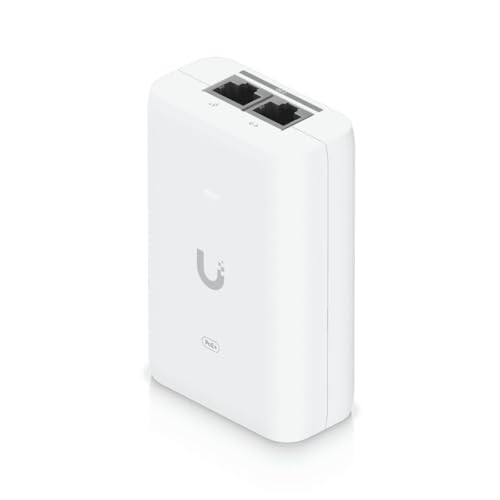
Ubiquiti Networks 2.5GbE 30W PoE+ Adapter
About this pick
This adapter's listing specifically states surge and clamping protection alongside a 100-240V AC input range and an operating range of 32 to 104F, a first-party Ubiquiti accessory suited to a broad range of UniFi and general 2.5GbE devices. Its shielded RJ45 socket streamlines installation without complex configuration.
Compared to the TRENDnet and Cudy picks above, this one is a first-party accessory from a specific major networking brand rather than a third-party generic unit, useful if brand-matched sourcing is a priority.
Best for buyers who specifically want a first-party Ubiquiti-branded 2.5GbE injector for a UniFi or general networking setup.
Best for: buyers who specifically want a first-party Ubiquiti-branded 2.5GbE injector
Check price on AmazonPros
- +First-party Ubiquiti branding for buyers prioritizing that sourcing
- +Wide 100-240V AC input for broad regional compatibility
- +Simple shielded RJ45 installation
Cons
- −No stated specific surge kV rating unlike the Cudy pick
- −No stated NDAA compliance or extended warranty
Farsiglink 2.5Gbps PoE+ Injector 30W
About this pick
This injector's listing specifically states support for 10/100/1000/2500Mbps Ethernet speeds at the lowest price in this comparison, with built-in protection against over-voltage, over-current, short circuit, and overheating. Its auto-detect 802.3af/at compliance automatically provides the appropriate power to compatible devices.
Compared to the three pricier picks above, this one delivers the same core 2.5Gbps speed and 30W power tier at roughly half the cost of the mid-range options, a reasonable choice for buyers prioritizing price over documented certifications.
Best for buyers who want core 2.5Gbps PoE+ performance at the lowest price in this comparison.
Best for: buyers who want core 2.5Gbps PoE+ performance at the lowest price
Check price on AmazonPros
- +Lowest price in this comparison by a wide margin
- +Multiple stated electrical protections
- +Full 2.5Gbps speed matching pricier alternatives
Cons
- −No stated NDAA compliance or specific surge kV rating
- −No named brand warranty length stated
How We Evaluated These 2.5GbE and 5GbE PoE Injectors
Each pick was assessed across 5 criteria weighted for real-world use.
Cabling over Cat5e
We checked whether each injector says it runs 2.5Gbps over existing cable. TRENDnet lists 2.5Gbps over Cat5e or better, which matters because many buildings already hold Cat5e and re-pulling cable can cost more than the injector itself. Test the negotiated speed after installing.
Power class and device draw
We compared output, 30W on all four, against 802.3at devices. A Wi-Fi 6E or 7 access point may need more than 30W when its radios run hot, so we marked 30W as enough for most and not for bt-class devices. Check the AP's rated draw before choosing a 30W unit.
Protection ratings
We read protection details. Cudy lists 4kV surge and 8kV ESD with Japanese-grade capacitors, Ubiquiti lists surge and clamping protection without a kV figure, and TRENDnet and Farsiglink state none, so we credited the documented ones. A surge rating matters most on exterior runs.
Warranty and compliance
We weighed paperwork. TRENDnet offers a 3-year warranty with NDAA and TAA compliance for institutional buyers, while Cudy, Ubiquiti and Farsiglink lack a stated compliance or a clear warranty length. Schools and agencies often cannot buy without compliance paperwork.
Input range and temperature
We compared practical limits. Ubiquiti takes 100-240V AC for regional compatibility, Farsiglink supports 100m at 2.5Gbps, and Cudy is rated for -10 to 40C, which limits it to indoor closets rather than hot attics. Hot attics are outside the Cudy's rated range.
How to Choose the Right 2.5GbE and 5GbE PoE Injectors
By Device Ecosystem
Every injector passes 2.5Gbps, but ecosystem fit changes setup.
| Your equipment | Recommended pick |
|---|---|
| A UniFi access point that you want in first-party hardware | Ubiquiti Networks 2.5GbE 30W PoE+ Adapter, with UniFi branding |
| A school or government network with procurement rules | TRENDnet 2.5G PoE+ Injector, TPE-215GI, which is NDAA and TAA compliant |
| An access point on a long unprotected cable run | Cudy 30W 2.5GbE PoE+ Injector (POE200H), with 4kV surge protection |
| A home access point on a tight budget | Farsiglink 2.5Gbps PoE+ Injector 30W, the lowest price by a wide margin |
By Budget
The Farsiglink is far cheaper than the rest, and TRENDnet is the most expensive.
| Budget | Recommended pick |
|---|---|
| The lowest price in this roundup | Farsiglink 2.5Gbps PoE+ Injector 30W |
| A mid-range spend for documented surge protection | Cudy 30W 2.5GbE PoE+ Injector (POE200H), which costs less than TRENDnet |
| A mid-range spend for a first-party brand | Ubiquiti Networks 2.5GbE 30W PoE+ Adapter |
| The top of the range for a 3-year warranty and compliance | TRENDnet 2.5G PoE+ Injector, TPE-215GI |
Documented Protection vs Warranty
Two of the picks stand out for different forms of insurance.
Documented protection (Cudy)
4kV surge and 8kV ESD ratings plus rated capacitors protect against the surge that hits cable runs, but no NDAA mark or long warranty is stated.
Written warranty (TRENDnet)
A 3-year warranty and NDAA and TAA compliance back the hardware on paper, but TRENDnet states no surge kV rating.
Default to Cudy for a surge-exposed run and TRENDnet when procurement or warranty matters.
By Cabling and Distance
2.5Gbps stays reliable only if the cable and distance allow it.
| Your cabling | Recommended pick |
|---|---|
| Existing Cat5e throughout the building | TRENDnet 2.5G PoE+ Injector, TPE-215GI, which states 2.5Gbps over Cat5e or better |
| A run close to the 100m limit | Farsiglink 2.5Gbps PoE+ Injector 30W, which lists up to 100m (328ft) |
| A short run where 802.3bz passthrough is the key | Cudy 30W 2.5GbE PoE+ Injector (POE200H), with 2.5GbE full passthrough |
| Mixed regions where the power supply must work worldwide | Ubiquiti Networks 2.5GbE 30W PoE+ Adapter, with 100-240V AC input |
For Home Wi-Fi 6E Access Points Specifically
Home installs need quiet, small and cheap injectors more than rugged ones.
Look for
2.5Gbps speed, 30W output and a PoE standard that matches the access point, in a body small enough to hide behind a TV cabinet.
In this comparison
Farsiglink 2.5Gbps PoE+ Injector 30W costs far less than the others and runs 802.3af and at, while Ubiquiti suits UniFi owners.
When to Spend More
Price rises here are for warranty and protection documentation.
Spend more if
You are buying for an institution or a long outdoor cable, where TRENDnet 2.5G PoE+ Injector, TPE-215GI or Cudy 30W adds documented compliance or surge ratings.
Save if
You are powering one home access point on a short indoor run, where Farsiglink 2.5Gbps PoE+ Injector 30W costs far less.
Frequently Asked Questions
Do I need a 2.5GbE PoE injector for a standard Wi-Fi 6 access point?
Most standard Wi-Fi 6 access points work fine on Gigabit speed, but Wi-Fi 6E and Wi-Fi 7 models under heavy multi-client load can genuinely exceed 1Gbps, making a 2.5GbE injector worth the upgrade for those newer models specifically.
Will a 2.5GbE PoE injector work over my existing Cat5e cable?
Often yes, since TRENDnet's listing states 2.5Gbps over Cat5e or better cabling and the Farsiglink lists up to 100m (328ft). Old or damaged Cat5e can still fall back to 1Gbps, so check the negotiated link speed after installing and replace any run that refuses to hold 2.5G before you close up the wall.
Is a first-party Ubiquiti 2.5GbE adapter necessary for a UniFi access point?
No, any compliant third-party 2.5GbE 802.3at injector should work with UniFi hardware, but a first-party adapter offers ecosystem consistency and direct brand validation if that matters to your setup.
What's the real benefit of documented surge protection kV ratings over a generic overvoltage claim?
A stated rating like Cudy's 4kV surge and 8kV ESD tells you how much of a spike the injector is built to absorb, while a generic overvoltage claim gives no number to compare. On a long outdoor cable run that attracts lightning-induced surges, the documented figure is the one worth paying a little extra for.
Can I use a budget 2.5GbE injector for a business network installation?
You can, but for a business setting where compliance or extended warranty coverage matters to a purchasing decision, a certified option with NDAA compliance or a longer stated warranty is often worth the extra cost.
Does 2.5GbE speed require a special network switch too?
Yes, to get the full 2.5Gbps end to end, the switch port feeding the injector and the access point or device on the far end must both support 2.5GbE. If either side is Gigabit, the link negotiates down to 1Gbps, and the injector then only provides the 30W of power rather than extra speed.
Bottom Line
best overall: TRENDnet 2.5G PoE+ Injector, TPE-215GI - best overall pick in this roundup.
See the full rankings above for all picks with pros, cons, and best-for summaries.
Browse on Amazon
All Prime-eligible options with current pricing.
Shop on Amazon →